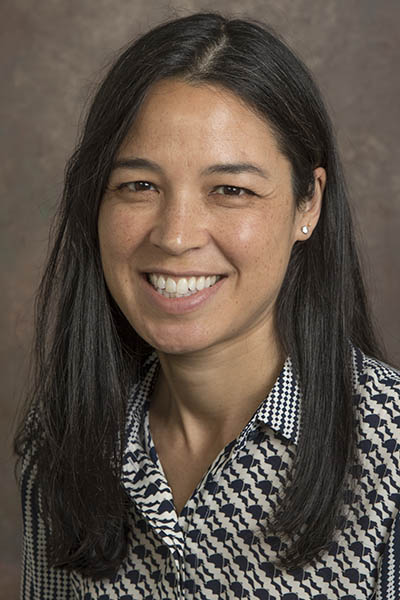
Faculty Profile
Millicent O. Sullivan
Alvin B. & Julie O. Stiles Professor of Chemical & Biomolecular Engineering and Department Chair
Education
- Post-Doctorate – 2006 Hope Heart Program at the Benaroya Research Institute
- Doctorate – 2003 Carnegie Mellon University
- Bachelors – 1998 Princeton University
About Millicent Sullivan
Millicent Sullivan is the Alvin B. and Julie O. Stiles Professor and Chair of the Department of Chemical & Biomolecular Engineering, and a Professor in Biomedical Engineering at University of Delaware. Millie graduated from Princeton University with a B.S.E. degree in Chemical Engineering and a Certificate in Engineering Biology in 1998. Subsequently, she attended Carnegie Mellon University as a Clare Boothe Luce Graduate Fellow, where she earned her Ph.D. degree in Chemical Engineering with Professor Todd Przybycien in 2003. As a Ruth L. Kirchstein NIH postdoctoral fellow, Millie worked with Professor E. Helene Sage in the Matrix Biology/Hope Heart Program of the Benaroya Research Institute. In 2006, Millie moved to the University of Delaware. Her laboratory develops new biomaterials for drug delivery, gene delivery, and tissue engineering, with therapeutic targets including metastatic breast cancer, bone repair, wound healing, and cardiovascular repair. Additionally, her lab recently began working in synthetic cell design using engineered polypeptides. Specific fundamental foci include de novo peptide design, peptide and polymer self-assembly, and subcellular processing mechanisms. Sullivan is Core Director in the Delaware COBRE Center for Musculoskeletal Research, a member of the Penn Center for Targeted Therapeutics and Translational Nanomedicine (CT3N), and an Affiliate Member of the Delaware Biotechnology Institute. She is an AIMBE fellow, past Standing Member of the Gene and Drug Delivery (GDD) study section at NIH, and Honorary Professor of Chemical Engineering at the University of Melbourne, and she has been the recipient of awards and honors including a Fulbright Future Award, the Centennial Professorship, the NSF CAREER Award, and the Merck Faculty Fellow Award.
Select Publications
For a complete listing of publications, please view the Full CV.
- Kelley, E.G., Albert, J.N.L., Sullivan, M.O.‡, and Epps, III, T.H.‡, “Stimuli-responsive Copolymer Solution and Surface Assemblies for Biomedical Applications,” Chemical Society Reviews, 42: 7057-7071, (2013)
- Kelley, E.G.*, Murphy, R.P.*, Seppala, J.E., Smart, T.P., Hann, S.D., Sullivan, M.O.‡, and Epps, III, T.H.‡, “Size Evolution of Highly Amphiphilic Macromolecular Solution Assemblies via a Distinct Bimodal Pathway,” Nature Communications, 5: 3599. doi:10.1038/ncomms4599, (2014)
- Ross, N.L., Munsell, E.V., Sabanayagam, C., and Sullivan, M.O., “Histone-Targeted Polyplexes Avoid Endosomal Escape and Enter the Nucleus During Post-mitotic Redistribution of ER Membranes,” Molecular Therapy Nucleic Acids, 4, e226, doi:10.1038/mtna.2015.2, (2015)
- Munsell, E.V., Ross, N.L., and Sullivan, M.O., “Journey to the Center of the Cell: Current Nanocarrier Design Strategies Targeting Biopharmaceuticals to the Cytoplasm and Nucleus,” Current Pharmaceutical Design, 22(9): 1227-1244, (2016)
- Greco, C.T., Epps III, T.H.‡, and Sullivan, M.O.‡, “Mechanistic Design of Polymer Nanocarriers to Spatiotemporally Control Gene Silencing,” ACS Biomaterials Science and Engineering, doi:10.1021/acsbiomaterials.6b00336, (2016)
- Urello, M.A., Kiick, K.L.‡, and Sullivan, M.O.‡, “Integration of Growth Factor Gene Delivery with Collagen-Triggered Wound Repair Cascades using Collagen-Mimetic Peptides,” Bioengineering & Translational Medicine, doi:10.1002/btm2.10037, (2016)
- Greco, C.T., Muir, V.M., Epps III, T.H.‡, and Sullivan, M.O.‡, “Efficient Tuning of siRNA Dose Response by Combining Mixed Polymer Nanocarriers with Simple Kinetic Modeling,” Acta Biomaterialia, doi:10.1016/j.actbio.2017.01.003, (2017)
- Urello, M.A., Kiick, K.L.‡, and Sullivan, M.O.‡, “ECM Turnover-Stimulated Gene Delivery through CMP-Plasmid Integration in Collagen,” Acta Biomaterialia, 62: 167-178, (2017)
- Munsell, E.V., Kurpad, D., Freeman, T., and Sullivan, M.O., “Histone-Targeted Gene Transfer of Bone Morphogenetic Protein-2 Enhances Mesenchymal Stem Cell Chondrogenic Differentiation,” Acta Biomaterialia, 71: 156-157, (2018)
- Lieser, R.M., Chen, W., and Sullivan, M.O., “Controlled EGFR Ligand Display on Cancer Suicide Enzymes via UAA Engineering for Enhanced Intracellular Delivery in Breast Cancer Cells,” Bioconjugate Chemistry, doi:10.1021/acs.bioconjchem.8b00783, (2019)
Patents (h3)
Lorem ipsum dolor sit amet, consectetur adipiscing elit. Sed vel nisi tristique enim dictum feugiat rhoncus et nisl. Sed pharetra.
Awards
For a complete listing of awards, please view the Full CV.
- Fellow, American Institute for Medical and Biological Engineering (AIMBE), 2017
- Georgia Tech Frontiers in Bioengineering Young Investigator, 2013
- Outstanding Junior Faculty Member in the College of Engineering, 2011
- Merck Faculty Fellow, 2008
- National Science Foundation (NSF) CAREER Award, 2008
Research Areas
Drug delivery, gene delivery, biomaterials and stimuli-responsive materials, tissue engineering and regenerative medicine